All the Dead of Kyoto
I originally wrote this story around the cherry blossom festival. Over the past month, I’ve revised it into an autumn Halloween story, set in Kyoto and following Dante Mori through the murder of a geiko.
© 2026 Michael Gabriel Viloria. All rights reserved. Copyright & permissions
She was exactly where I'd said she would be. I'd only been wrong about when I would find her.
At 5:52 on the morning of October 31st, the light came up grey over the Higashiyama hills and the Kamo River turned from black to pewter, and a man walking a small white dog along the embankment below Pontochō stopped, and the dog stopped with him, and neither of them moved.
I was eighty metres north. I'd been on the riverbank since six the previous evening. Twelve hours, walking the stretch between the Sanjō and Shijō bridges and back, over and over, the same kilometre of packed gravel. I'd counted the bridges' lamps. I'd counted the drunk. I'd watched the Friday-night crowds come down the stone stairs in costume: vampires, nurses, zombies in office suits, three separate Pikachus, a group of university students dressed as the cast of a ghost story, white faces and loose black hair and white triangles of cloth tied around their foreheads. Halloween weekend. Kyoto had come to Halloween late, and now it made up for lost time.
The man with the dog had his hand over his mouth.
I was already running.
* * *
She lay face-up in the Misosogi, the narrow stone channel that runs between the river embankment and the backs of the Pontochō teahouses, in perhaps forty centimetres of water. White kimono, plain, the cheap cotton kind sold for funerals. Wrapped the way you wrap the dead, right panel over left. White face. Black hair loose in the water, spreading. Across her forehead, tied at the back, a white triangle of cloth.
A yūrei. Every ghost in every Japanese story since the Edo period looks like that. Every one of the students I'd seen at midnight had looked like that.
The difference was in the details. Under the white, her face was made up with the precision of someone who'd done it thousands of times: red at the corners of the eyes, the bare two-pronged stripe at the nape where the white stopped, the lips painted smaller than her real mouth. Not a costume. A geiko's face, under a ghost's clothes.
"Don't," said the man with the dog, in Japanese, when I stepped down onto the stone lip of the channel. "Don't touch her. I've called the police."
"I won't," I said. "I'm only looking."
I looked. Her hands, palms up. Her feet in white tabi, no shoes. The water barely moving around her. I didn't step in. I didn't need to.
Then I took out my phone and called the number I'd called at 6:04 the previous evening, and when the same desk officer answered I said, as calmly as I could manage:
"This is Dante Mori. I called you last night. I told you a fourth woman would be found on the Kamo riverbed between Sanjō and Shijō before dawn." I watched the water move her hair. "She's here."
* * *
The first patrol car came down the ramp by the Shijō stairs at 6:03. The forensic van at 6:20. By half past six the embankment was taped off and a dozen people in uniforms and blue overshoes were working the channel, with a growing crowd behind the tape: joggers, dog-walkers, a few bleary survivors of the night still in costume. A girl in cat ears was crying. A young man in a Dracula cape filmed everything on his phone until an officer made him stop.
I stood just outside the tape and watched them work. It took four minutes for an officer to notice me watching, two more for him to ask me to move along, and thirty seconds for me to explain who I was and that I'd made the call, which sent him off to find someone more senior.
The someone more senior arrived at 6:41.
She was in her mid-forties, compact, in a grey suit under a dark raincoat that had been well made and badly treated. She walked down the embankment in flat shoes with her hands in her pockets, stopped, looked at the channel for a long time, looked at the crowd for a little longer, and then looked at me.
"Morikawa," she said. "First Investigation Division, Prefectural Police." Standard Japanese, precise, a Kyoto softness at the edges she was holding back. "You're the Canadian."
"Dante Mori."
"You called the Nakagyō station at six last night and told the desk sergeant that the man killing these women would leave his fourth on the Kamo riverbed. Between Sanjō and Shijō. Between midnight and dawn."
"Yes."
"The desk sergeant logged it as a crank call."
"I know. I could hear him doing it."
"He's going to be very unhappy today." She looked at the channel again. "So am I. Tell me why I shouldn't take you to the station right now as the most interesting person on this riverbank."
"Because I was on this riverbank for twelve hours," I said, "and I'm about to tell you everything I saw. And because you already know it wasn't me, or you'd have had me brought to you instead of walking over yourself."
She considered that the way you'd consider a fly that had landed on your sleeve.
"Talk," she said.
* * *
I'd read about the first one in Vancouver, in the Kyoto Shimbun, which I read the way other people read the sports page. Okamura Shizuko, sixty-one, owner of a public bathhouse in Nishijin, found at dawn on Saturday the 10th of October in the old burial grounds near Funaokayama, in the north of the city. White funeral kimono, right over left. White face. Loose hair. The white triangle on her forehead. Police were treating it as suspicious.
The second, a week later, on the 17th. Tanabe Yuriko, thirty-four, heir to a small family ryokan near Gojō, found in the cemetery grounds below Toribeyama, in the east.
The third on the 24th. Kuwabara Emi, forty-seven, who ran her family's incense shop in an old machiya on Teramachi. Found at Adashino, in the west, among the thousands of small stone Buddhas at Nenbutsu-ji.
By then the papers had a name for it: the Ghost Killings. Friday nights. Women dressed as ghosts. Haunted places. The weeklies ran maps and theories about curses and occult societies. A television psychic suggested the Night Parade of a Hundred Demons.
I'd booked a flight on the 24th. Nobody had asked me to. Nobody had hired me. I'd noticed that I hadn't thought about anything else for two weeks, which is how I recognise an addiction, and I've learned that with some addictions it's easier to finish them.
"Rendaino," I said to Morikawa. "Toribeno. Adashino. For a thousand years those were where Kyoto took its dead. North, east and west. The three great burial grounds." I nodded at the river. "And the riverbed. The people nobody claimed, the poor, the executed. Sanjō-gawara was an execution ground for centuries. Heads were displayed on this bank. The fourth place the city put its dead."
"So you assumed he'd come here."
"Three Fridays in a row, a week apart, three of the four places. October 30th was a Friday. And Halloween weekend, when this riverbank is full of people dressed exactly like his victims." I paused. "I was wrong about the stretch. I watched the Sanjō end most closely. I thought he'd want the execution ground itself."
Morikawa was quiet for a moment.
"That isn't in any report," she said. "The burial grounds. We had a historian look at the sites. She said haunted places and gave us a list of forty."
"It isn't a list of haunted places. It's a list of the city's graves."
She took a notebook out of her pocket. An actual paper notebook. I liked her slightly more.
"What did you see last night?"
I'd spent the last forty minutes putting it in order. I gave it to her that way.
"Six to nine, families, tourists, couples. Nine to midnight, the costume crowds, mostly university age, coming down from Kawaramachi. Peak around half past eleven, perhaps three hundred people on this stretch. A fight between two men dressed as different superheroes at 11:50, broken up by friends. Midnight to one, crowds thinning, mostly couples and groups heading home. At 1:07, at the Shijō stairs, a couple coming down. A man in a dark coat, mid-forties, tall, half-carrying a young woman dressed as a yūrei. White kimono, white face, loose hair, white triangle. Her head on his shoulder. Her feet in white tabi, no shoes, dragging. Two groups on the embankment laughed and filmed them. Someone called out that she'd lost her shoes. The man raised his free hand without turning round. He walked her south, toward the dark stretch below the teahouses, and I…"
I stopped.
Morikawa looked up from her notebook.
I'd watched them for perhaps nine seconds. I'd noted his gait: a slightly short step on the right, the right foot turned out a few degrees, like a man protecting an old injury to the knee. I'd noted her feet dragging. And in less time than it takes to say it, I'd classified them as drunk girl, costume, boyfriend, and turned back to watch the Sanjō end for a man walking alone.
Because that's what I'd been looking for. A man alone, carrying something. Not a man helping his drunk girlfriend home on Halloween weekend. Not a ghost and her date, in a crowd of ghosts and their dates.
"I saw them," I said. "At 1:07. I watched them go south. And I filed them as a costume."
For a long moment Morikawa didn't say anything at all.
"Hundreds of people saw a costume last night," she said finally. Not unkindly.
"I'm not hundreds of people," I said. "I was looking for him."
* * *
There's a way people stand at the back of a crowd at a crime scene that I've seen in four countries. Most of them lean forward. They want to see. They hold up their phones and talk to each other in low voices and point.
A few don't. They stand very still, at the back, slightly to one side. They don't take pictures. They don't talk to anyone. They watch the police more than the body.
There was one at the back of the crowd on the Shijō side. Mid-forties. Tall. A good grey overcoat over a dark suit, as if on his way to an office on a Saturday. A paper coffee cup he wasn't drinking from. He stood with his weight set on his left leg, the right a little forward and turned slightly out, the way you stand when you've learned not to load a knee that has opinions.
I watched him for about four seconds. He was watching Morikawa.
Then he turned, unhurried, and walked up the stone stairs toward Shijō. His right step was a few centimetres shorter than his left. He was gone among the morning crowds.
I didn't follow him. I made a note of him. Everything I'd done in the last twelve hours had been the wrong thing in a confident voice, and I wasn't going to chase a stranger up a staircase because of the way he held his knee.
I've regretted that, too. But less.
* * *
They identified her by nine. Harada Mio, twenty-four. A geiko in Pontochō, under the name Kanoha. She'd been entertaining at a teahouse called Kikunoya on Friday night and had left at around eleven to walk home. Her okiya was less than three hundred metres away. She never arrived.
The preliminary examination put her death before midnight. Whatever I'd watched come down the Shijō stairs at 1:07, it had already been over for more than an hour.
By ten, the task force had a suspect.
Morikawa told me at a coffee shop on Kiyamachi, beside the Takase canal, where she'd agreed to meet me only, she said, because it was easier than having me arrested for following her. She ordered black coffee and didn't touch it.
"Hayama Ren," she said. "Thirty-nine. He runs ghost walks. Kyoto Kaidan Night Tours. Two hours of haunted Kyoto for tourists, in English and Japanese, for six years." She showed me a promotional photo on her phone: a thin, bearded man in a black haori, holding a paper lantern and grinning. "His tours stop at Rokudō Chinnōji, the old well to the underworld. At Toribeyama. At Sanjō-gawara, where he tells the story of the executions. He has a page on his website about Kyoto's burial grounds. He's been posting about the killings every week. Theories. Maps. Three of his customers reported him as strange. He was arrested an hour ago."
"Where was he last night?"
"Running a tour. Eleven to one. It finished at Yasaka Shrine."
"Witnesses?"
"Fourteen paying customers."
"Photographs?"
She paused. "Several of them posted pictures of him at Yasaka. The last one is timestamped 1:09."
"And at 1:07 I watched a man carry her down the Shijō stairs. A kilometre away, through the crowds." I shook my head. "He's not your man. Your man doesn't love ghosts."
Morikawa looked at me.
"Hayama loves ghosts," I said. "It's his whole business. If he staged these, they'd be performances. A lantern. A willow branch. Something from the stories. Whoever is doing this gets every detail right and adds nothing. Right panel over left. The triangle. White funeral cotton, the kind you'd buy at a funeral supply shop without anyone looking twice. It's correct the way a form is correct." I turned my cup slowly. "He isn't making ghosts. He's making a pattern that looks like ghosts, so you'll look for a man who loves them."
"You've decided this in a coffee shop."
"No. From four women." I looked at her. "What else did they have in common? Not the ghosts. The women."
"Nothing. Different ages. Different wards. A bathhouse owner. A ryokan heir. An incense seller. A geiko. None of them knew each other."
"A bathhouse, a ryokan, a shop in a machiya, a teahouse," I said slowly. "All four businesses are in old buildings. All four women either owned the building or were going to inherit it."
Morikawa didn't move.
"Except Kanoha," she said. "She's a geiko. She doesn't own a teahouse."
"Not yet," I said. "I'd like to talk to the teahouse."
"You can't. It's Pontochō. Nobody gets through that door without an introduction."
* * *
I didn't try the door.
I went round to the river side, to the backs of the houses, and found Kikunoya from the embankment: a narrow wooden veranda running along the back of the house above the channel, forty metres north of where Kanoha had been found. I waited in the cold on the gravel below it until, a little after eleven, a geiko in her thirties came out onto the veranda without her wig or makeup, in a padded jacket over a cotton yukata, to stand in the wind and cry where nobody inside could hear her.
When she saw me she went very still.
"I'm not police," I said, up toward the veranda. "And I'm not press. I was on this riverbank all last night. I saw her come down the Shijō stairs."
She stared at me.
"I didn't know it was her," I said. "I thought she was a costume. I'm going to find the man she was with."
There was a long silence. Then she went inside, and I thought that was the end of it, until a small wooden gate in the wall at the end of the veranda opened onto the channel and she said, without any expression at all, "Come up."
I waded across. The water was shin-deep and very cold.
* * *
Her name was Kotomi. She was Kanoha's onēsan, her older sister in the Pontochō sense: the senior geiko who'd sponsored her as a fifteen-year-old maiko and been responsible for her ever since. She took me into a small back room on the ground floor. Through a half-open sliding door I could see the front room: tatami, a tokonoma with white chrysanthemums, the foot of a staircase so steep it was nearly a ladder. An old woman in a grey kimono sat there alone, very straight, not moving.
"The okāsan," Kotomi said quietly. "She hasn't moved since the police came. She won't eat."
"Tell me about last night."
"A banquet. For a man from Tokyo. Kurokawa." She said the name as if it had a taste. "A developer. Hotels. For a year he's been trying to buy Kikunoya. Luxury traditional experiences." The phrase in English, flat as a board. "The okāsan always refused him the Kyoto way. Politely. Never quite a no. Last night he made a final offer. Very large. And she told him, very clearly, that she'd made a will in September. Kikunoya would go to Mio. It would never be sold."
"How did he take it?"
"He smiled. He paid. He left with his guests at eleven." She looked at her hands. "Kanoha left a few minutes later. She was going straight to the okiya. Three hundred metres." Her voice broke on the number.
"Had Kurokawa's company sent anyone else? Before last night?"
She frowned. "A field man. From his acquisitions office. He came three times this year, with letters. Very polite. He always stood in the genkan; he never took his shoes off to come in."
"Did you meet him?"
"Once. I opened the door." She thought. "Tall. Forties. A good coat, like a salaryman." She hesitated. "He looked at everything. Not at me. At the house. The stairs, the back door, the windows. Like a man counting."
"Did he walk with a limp?"
Kotomi looked at me sharply.
"Not a limp," she said slowly. "But he stood like this." She shifted her weight onto her left leg, her right foot a little forward and out. "I thought he had a bad knee. I thought it was a pity, for a man that age."
"What happens to Kikunoya now?"
She glanced through the doorway at the old woman.
"She says she'll give it to the association. Pontochō's geiko. On Monday. A gift, in Mio's name, so it can belong to all of us and never be sold." Kotomi's mouth trembled. "She telephoned them at noon. And at two Kurokawa's office is calling to offer condolences. They've already asked when they may call."
"Will she tell them?"
"She will tell them," Kotomi said. "She'll want him to know."
* * *
I called Vivian from the embankment at three. It was eleven at night in Vancouver. She answered on the second ring in the voice of a woman who'd been asleep for four minutes.
"You're in Japan," she said. "You're not working for anyone. You've been there a week. And you're calling me at eleven o'clock on a Friday."
"Saturday."
"Not here. Conclusion."
"I need to know whether a Tokyo development company, or anything tied to it, made offers this year on four properties in Kyoto. A public bathhouse in Nishijin, a ryokan near Gojō, an incense shop on Teramachi, and a teahouse in Pontochō called Kikunoya. And if so, who signed the letters."
Silence. Then the sound of Vivian sitting up, and a laptop opening.
"Name of the company?"
"Kurokawa Development. Or whatever it uses for acquisitions. They won't buy under their own name."
"No, they won't." Keys. "You think a property developer is killing people for real estate."
"I think four women each stood between someone and a building. And I think whoever did this dressed them as ghosts so the police would go looking for a man who believes in ghosts."
Keys. A pause.
"I have a due-diligence contact in Tokyo who owes me a favour and is awake," Vivian said. "Give me an hour. And Dante?"
"Yes."
"If you're right, they'll have done this through three subsidiaries, a consultancy and a man nobody on the board has ever met. Don't go looking for a memo. There won't be one."
"I know."
"I know you know. I'm saying it so you'll remember it when you're tired." A pause. "Are you tired?"
"I haven't slept since Thursday."
"Then sleep. I'll call you."
I didn't sleep. She called back in fifty-two minutes.
"Sakuragi Estate Partners," she said. "Osaka-registered. Sixty percent owned by a holding company that Kurokawa Development owns outright. In the last fourteen months Sakuragi sent written offers, three each, to all four of your properties. And to nineteen other old properties in central Kyoto, most of which have since sold. The letters are signed by their senior field representative." A pause. "Nishida Kōji. Forty-six. Before Sakuragi, eighteen years with the Osaka Prefectural Police. Medical retirement four years ago, after a knee injury during an arrest."
I looked at the river. At the stone stairs at the Shijō end, where at 1:07 a man with a short right step had brought a ghost down to the water.
"He knows how investigations work," I said. "What you look for. What you don't."
"I'll send you a photograph," Vivian said. "From a property seminar last year. Then call the police. Not tomorrow. Now."
* * *
The photograph came through at 4:05. A man in a dark suit at a lectern, in front of a slide that read Revitalising Kyoto's Heritage Assets. Tall. Mid-forties. Short, neat hair. Standing, even at a lectern, with his weight on his left leg and his right foot turned a few degrees out.
The man at the back of the crowd at dawn, with the coffee he didn't drink.
I sent it to Morikawa with three lines:
Nishida Kōji. Field man for Sakuragi Estates, Kurokawa's acquisition arm. Signed offers to all four victims.
He was in the crowd at the scene this morning. I watched him leave.
Ex-Osaka police. Bad right knee. The man on the Shijō stairs at 1:07 had a short right step.
She called forty seconds later.
"Where are you?"
"On the riverbank behind Kikunoya."
"Of course you are." A breath. "Hayama's lawyer is shouting at my superintendent. My superintendent is shouting at me. And a man nobody's heard of, who isn't even resident in Japan, wants me to tell a task force of sixty officers that their suspect is the wrong man and the real killer is a retired policeman who works for a respectable developer."
"Yes."
"Do you have evidence?"
"I have a pattern, a motive, a man in a crowd and a knee."
"That isn't evidence."
"No," I agreed. "It's a direction. Look for his car on Friday night. Look for where he was on the 9th, the 16th and the 23rd. Look for a funeral supply shop that sold four white kimono to one man. And look at every video those tourists took on the Shijō stairs at 1:07. There'll be dozens."
Morikawa was quiet.
"And he isn't finished," I said.
"He's killed at all four places. You said so yourself. The sequence is complete."
"That was the ghost sequence. That was for you." I looked up at the back of Kikunoya, at the dark window of the room where an old woman sat alone and wouldn't eat. "The real sequence is buildings. Kikunoya still isn't sold. Last night the okāsan told Kurokawa that Kanoha was her heir. Now she has no heir. At noon today she told the geiko association she'll give them the house on Monday, so it can never be sold. At two, Kurokawa's office called with condolences. She'll have told them. Kotomi says she'd want him to know."
The line was very quiet.
"If she dies before Monday," I said, "the house goes to her estate. Estates sell."
"Another ghost—"
"Not a ghost. He's an ex-policeman. He knows you have a man in custody. Another ghost in white cotton, while Hayama's in a cell or newly released, points straight back at a killer who's still free." I watched the water. "An old woman. Grieving. Alone in her house at night, on a staircase that's nearly a ladder. Nobody would ask questions. That's what I'd do."
"That's a very unpleasant sentence, Mori-san."
"I know," I said. "That's why I'd like you to believe it."
There was a long pause.
"Tonight is Halloween," she said slowly.
"And Pontochō will be full of people in masks from nine until three in the morning, and nobody in that alley will look twice at anyone."
* * *
Pontochō on Halloween night is not a place. It's a pressure.
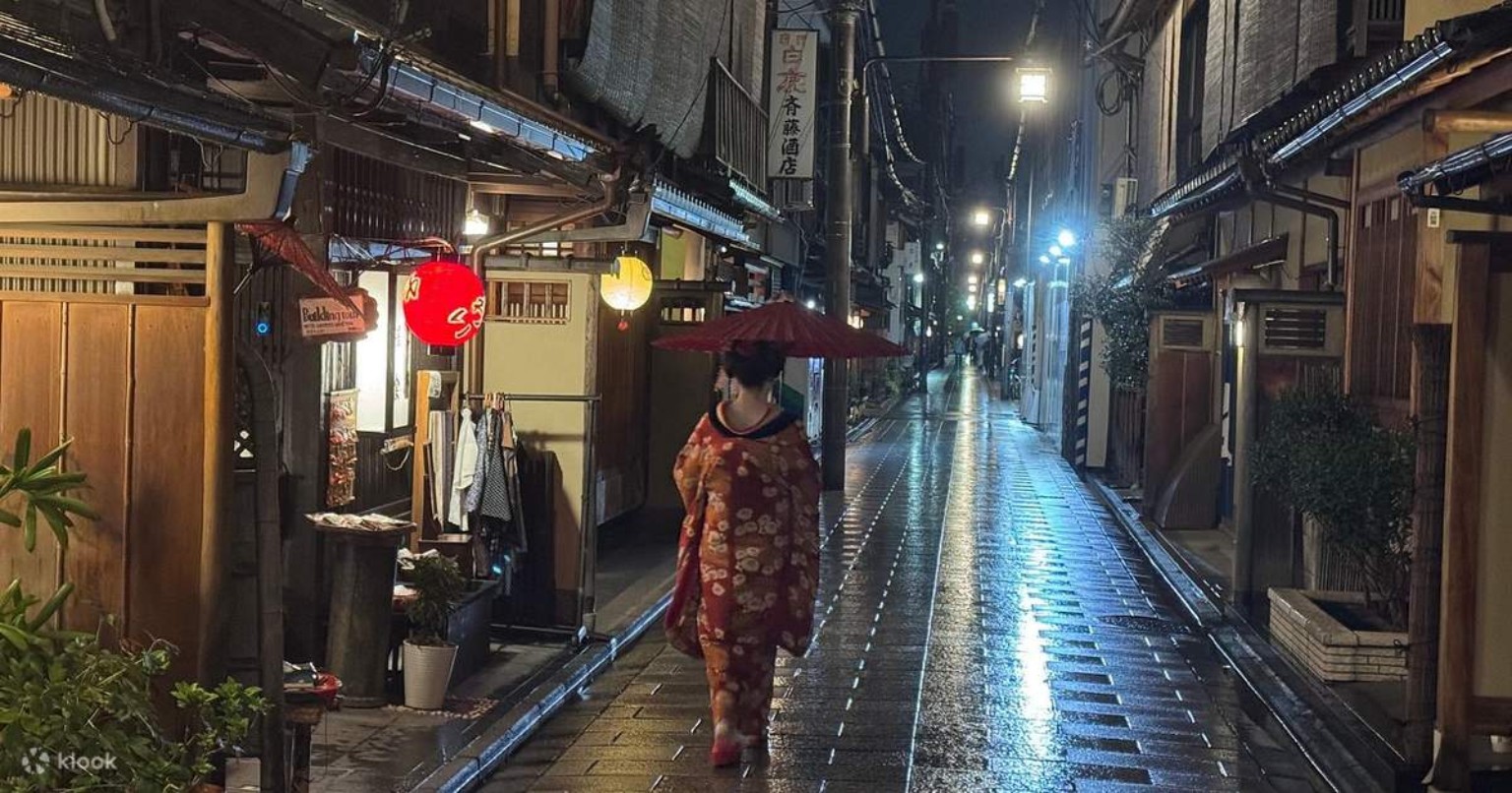
By ten o'clock the alley was so packed you moved with it rather than through it. Vampires. Witches. Office workers in bloody bandages. A dozen cheap geisha costumes, rented wigs like black helmets, white face paint applied with a sponge, red collars on women dressed as geiko and white collars on women dressed as maiko, everyone wrong in exactly the same confident way. Paper lanterns overhead printed with the district's little white plovers, marching north. Phone screens flashing. Shopkeepers stood in their doorways with arms folded. Someone had taped a fresh sign to Kikunoya's noren: Closed for mourning.
Morikawa's superintendent had given her four plainclothes officers and the instruction that this was a welfare check on a bereaved woman and nothing else. Two were in the alley, one in a doorway across from Kikunoya's front door. Morikawa had put the other two at the bridges, Shijō and Sanjō, well away from the dark stretch of embankment behind the house. A former policeman knows how plainclothes officers stand. I'd told her that twice. She'd told me twice that she had been a plainclothes officer for twenty years and knew it better than I did.
I was on the river side, on the veranda behind Kikunoya, in the dark. Kotomi was inside, in the back room. The okāsan was in the front room, where she'd refused to move from all day. Kotomi had begged her to go to the okiya. She'd said, very quietly, that this was her house.
I didn't watch the faces. Faces were useless tonight. Half were painted and the other half were masks.
I watched the knees.
At 11:38, a man in a long black coat and a white hannya mask, the horned demon-woman of Noh theatre, gold eyes, open snarling mouth, came along the embankment from the Shijō end, alone. Plenty of people were wearing masks. Several were wearing that one; you could buy it in any costume shop on Kawaramachi.
His right step was a few centimetres short. His right foot turned a few degrees out.
He carried nothing except a dark canvas bag over his left shoulder.
He stopped on the gravel below the house next door. Looked up at the dark windows. Then along the channel toward the back of Kikunoya, toward the narrow wooden gate at the end of the veranda. The same gate Kotomi had opened for me that morning, whose lock I'd checked afterward: old enough to open with a card.
He was a careful man. He waited a full minute. Then he stepped down off the stone lip into the channel and waded across toward the gate, shin-deep, the water barely moving.
I spoke into the phone in my pocket: "River side. Now."
Then I went down to meet him.
* * *
He saw me when I was three metres away. Gold demon eyes. Behind them, a man reading my weight and stance in under half a second, exactly the way I was reading his.
Eighteen years of police work. Trained. Perhaps fifteen kilos heavier than me. Standing in shin-deep water on the uneven stone floor of a channel, at night.
Bad right knee.
I had all of that in the first half-second and could have kept going. Weight distribution, likely first move, the bag, what was in it, his reach, the gate behind him, the wall on his left, the officers who were at least a minute away. All of it accurate, and all of it too slow.
You didn't see it. You named it.
Water hit my shins like ice.
Nishida drove forward off his good leg, shoulder first.
I turned.
Not enough.
His shoulder clipped my chest and sent me back half a step. My heel slid across algae-slick stone. The canvas bag swung between us, heavy enough that whatever was inside struck my hip.
His left hand caught my collar.
Too close.
Good.
I came inside the grip before he could use it, forearm against his chest, elbow rising hard beneath the mask. The white hannya snapped sideways. One horn raked across my cheek.
He grunted and swung the bag at my head.
I ducked.
It passed close enough to move my hair.
He followed it, turning through the miss, exactly what a trained man should do.
His right foot came down.
The bad one.
There.
My heel drove into the outside of his knee.
He folded with it instead of against it. Better than most.
His fist caught my ribs anyway.
Air left me.
Stone shifted under my foot.
He grabbed for my throat.
I caught the wrist, stepped across him and pulled while his weight was still searching for somewhere to go.
For half a second we were both falling.
Then I found the bottom.
He didn’t.
I turned my hips and sent him sideways.
His knee struck stone first.
Crack.
Not loud.
Worse than loud.
Nishida made one short sound and disappeared into the channel.
Water exploded around us.
The hannya mask tore free, landed face-up and drifted away on the current, gold eyes staring at nothing, its red mouth still snarling as Kyoto carried it toward Shijō.
I stayed standing because sitting down seemed premature.
My lungs disagreed.
Breathe.
Torches. Running feet on gravel. Morikawa's voice, very calm, giving orders. Two officers in the water. A third pulling the canvas bag up onto the embankment and opening it. Thin gloves. Fabric overshoes. A small torch. A ring of keys on a cheap tag stamped Sakuragi, one of them cut new.
No white kimono. No triangle of cloth.
Nishida Kōji lay on his side in forty centimetres of water, holding his right knee with both hands, and looked up at me. Not at the officers. At me.
"You were the man on the embankment last night," he said. Very quietly. Almost conversationally. "By the Sanjō stairs. Watching the wrong end."
"Yes," I said.
He nodded slowly, as if confirming a figure he'd already calculated.
"I saw you," he said. "I thought you were waiting for someone."
* * *
It was past two when they finished. The crowds in Pontochō had thinned to stragglers: a few vampires on the steps of a closed bar, a girl in a cheap geisha wig carrying her shoes. Up the alley, the plovers still marched north.
Morikawa found me on the embankment below Kikunoya, wet to the knees, sitting on the stone step at the edge of the channel. She sat down beside me without asking. For a while neither of us said anything.
"A funeral supply shop on Gojō," she said at last. "The owner remembers a tall man with a bad knee who bought four white kimono at once in September. Paid cash. He thought it was for a family tragedy." She looked at the water. "His car was parked on Kiyamachi on Friday night from 11:20 to 1:30. Forensics found a geiko's hairpin under the passenger seat. The tourists' videos of the couple on the Shijō stairs are already online; someone has set one to music. One of them shows his right foot quite clearly." Her mouth tightened. "One of the keys in his bag was cut for Kikunoya's back gate. Last week."
"Kurokawa?"
"Will be very surprised, and very sorry, and very well represented." She watched the river. "Nishida will say he did it alone, for the bonus. Sakuragi pays its field men a percentage of every completed purchase. Your friend in Vancouver says there'll be no memo." A pause. "There's never a memo."
"No."
"Hayama was released at nine this evening. He cried, apparently. He wants to put the case on his ghost tour." She sounded tired. "He'll probably make money from it."
The river ran by in the dark, black and quiet. Somewhere downstream a last group of students was singing.
"You're the most infuriating person I've ever worked with," Morikawa said.
"We didn't work together. I inserted myself."
"That's what's infuriating." She didn't look at me. "You called a police station with a crank theory. You stood at my crime scene and told me my suspect was wrong. You went round the back of a house I couldn't get into and got in. You had a woman in another country read corporate registries in the middle of her night. You told me where he'd come, and when, and why, and you were right." A pause. "And you didn't tell me you'd decided to wait for him in the river yourself."
"You'd have stopped me."
"Yes."
"He'd have seen your officers. He was a policeman."
"Yes," she said. "That's also infuriating."
I looked at the Shijō stairs. Empty now, under a single lamp.
"I watched them for nine seconds," I said. "At 1:07. I saw his knee. I saw her feet dragging. I saw her head on his shoulder. Everything I needed was in front of me, and I put it in the wrong box because it looked like everything else on this riverbank." I paused. "A ghost and her boyfriend."
Morikawa was quiet for a long time.
"Every August," she said finally, "Kyoto lights fires on the mountains to send the dead home after Obon. The Daimonji. Thousands of people come to watch. Most of them are there for the fires, the crowds, the photographs. They don't think about who the fires are for." She looked at the river. "Last night you were standing in a crowd of costumes, watching for a monster. You saw a costume. Of course you did. That's what everyone around you had come to see." She turned her head and looked at me properly for the first time all night. "But you were the only one on this riverbank who'd come for the dead. That's why she was found today and not next week. And that's why the okāsan is still upstairs."
I didn't have a reply to that. I didn't try to make one.
She stood and brushed off her coat.
"Next time you know where a body is going to be, Mori-san, don't call the front desk."
She took out a card and held it out to me. Her name. A mobile number, handwritten on the back.
"Call me," she said.
I took it.
She went back up the stone stairs toward Shijō, through the last of the costumes, a grey woman among vampires, and didn't look back.
I sat on the edge of the channel a little longer, in the cold, where Kanoha had lain twenty hours before. The water went south, the way it had gone for a thousand years, past the place where the city once displayed its executed, past the backs of the teahouses, toward the sea. Above me, in a house that would soon belong to the women who danced in it, a light came on in an upstairs window. After a while I heard, very faintly, a shamisen being tuned, and then a few notes, and then nothing.
It took me a long time to stand up.
Stay for the next story.
Get a short email when I share new stories, novel excerpts, world notes, or blog posts.
Choose your alerts after signing in.
Unsubscribe anytime.
Comments
Share your thoughts. Please keep it respectful and flag spoilers.
Sign in to your reader account to comment or reply. Everyone can read the discussion.
You can remove comments as the author.
Loading comments…