Ghosts in the Grid
Kyoto in October, a parade of monsters, and the words behind “All the Dead of Kyoto.”
© 2026 Michael Gabriel Viloria. All rights reserved. Copyright & permissions
Kyoto is haunted. I don’t mean that literally. Probably.
I mean that some cities feel old, and Kyoto feels occupied. Like someone was here before you, never really left, and is mildly annoyed that you’re standing in their doorway.
I was there over Halloween, and I’ve been carrying that feeling around ever since. It’s partly why my newest short story, All the Dead of Kyoto, exists. So this post is part travel diary, part behind-the-scenes, and part glossary, because I threw a lot of Japanese words at you in that story and only some of them were on purpose.
Fall in Kyoto
Fall in Kyoto has a very specific mood. The maples start turning. The air gets crisp at night. The river goes dark early, and the lanterns come on along the old streets one by one.
Then there are the streets themselves. Narrow. Stone. Lined with wooden townhouses that have been standing longer than my country has been a country. Sliding doors. Paper screens. Little curtains hanging in doorways that tell you a place is open without telling you whether you’re welcome.
Walk through Gion after dark and it’s quiet in a way cities aren’t supposed to be. You hear your own footsteps. You hear the river. Every so often a door slides shut somewhere and you have no idea where.
It is, to be clear, extremely romantic. It is also exactly the kind of place where, if you write mystery fiction, your brain goes: someone could absolutely disappear here.
Sorry, Kyoto. Occupational hazard.
The Night Parade
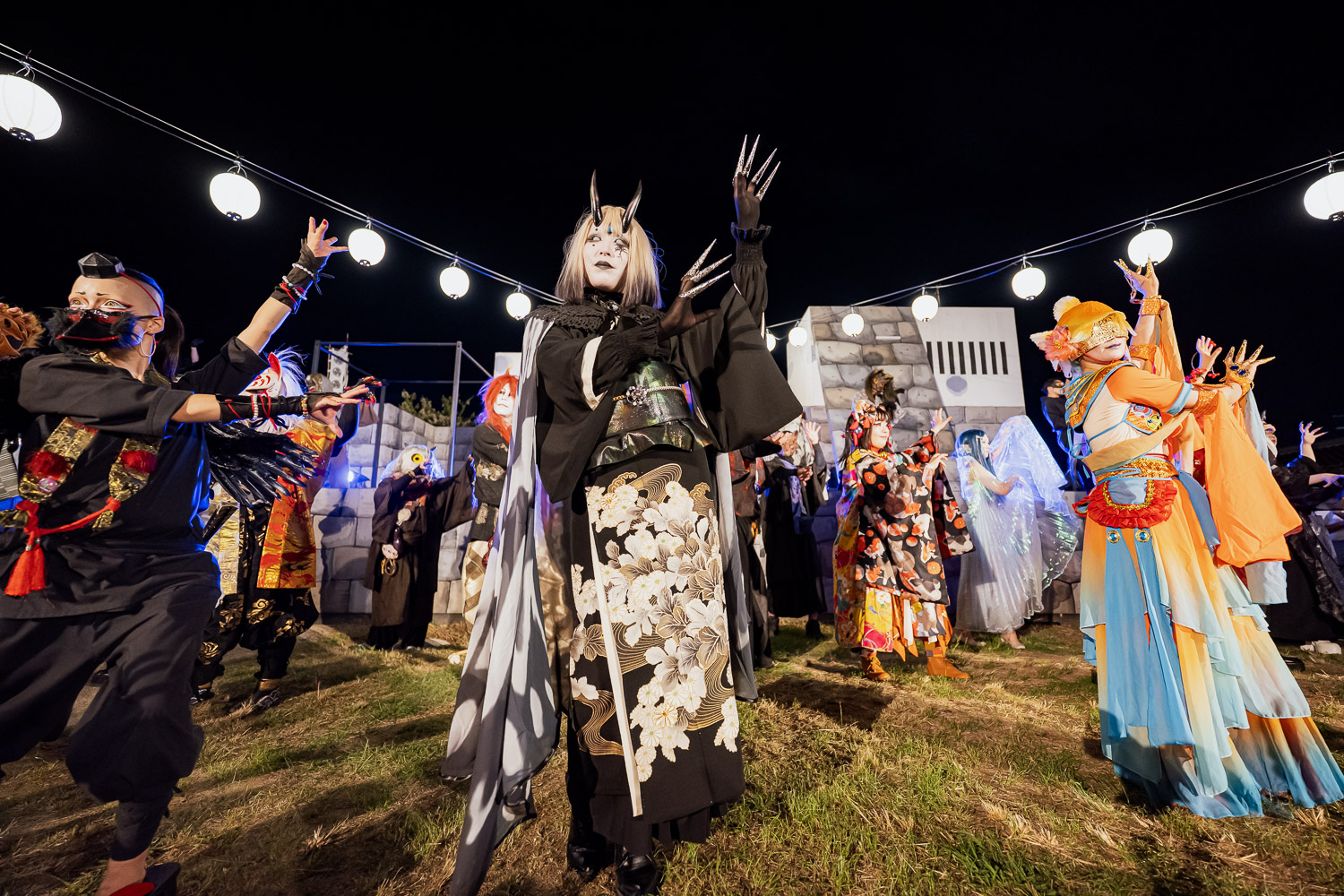
The highlight of the trip was the Hyakki Yagyō, the Night Parade of One Hundred Demons. (I have been calling it the March of a Thousand Demons for months. It’s a hundred. I’ve been inflating the monster count. Classic tourist.)
The legend goes back over a thousand years. On certain nights, a procession of yōkai, Japanese spirits and monsters, was said to march through the streets of the old capital. Anyone who saw it was in serious trouble. Some versions say the monsters were tsukumogami: old household objects that had been thrown away and came back to life, angry about it. Umbrellas. Lanterns. Teapots. Holding a grudge for a century.
Today there’s a stretch in northwest Kyoto, the Taishōgun shopping arcade along Ichijō Street, that has leaned all the way in. Locals call it Yōkai Street. There are monster figures in the shop windows and handmade creatures outside the stores. And once a year, people dress up and walk the parade route at night.
I watched it go by. Masks. Horns. Long-necked women. Things with too many eyes. Things that were clearly an umbrella with a tongue. And somehow none of it felt cheesy. It felt like the city remembering something.
Fun fact: in All the Dead of Kyoto, a TV psychic blames the killings on the Night Parade. He’s wrong. But I’ll admit I understand where he was coming from.
Halloween in Japan
If you’re picturing trick-or-treating, kids with pillowcases and porch lights, that’s not really it.
Halloween in Japan is mostly a costume party for adults. It grew over the past couple of decades through theme parks, shops and nightlife, and now it’s a real thing: pumpkin-flavoured everything in convenience stores, costume shops packed in October, and big crowds of people in very committed outfits.
Tokyo’s Shibuya is the famous one. It got so chaotic that the city now bans drinking on the street around Halloween and basically begs people not to come. Kyoto’s version is smaller, but the downtown nightlife areas around Kawaramachi still fill up with vampires, zombies and an alarming number of Pikachus.
What struck me most was the contrast. Ten minutes from a street full of rubber masks are old lanes where people have been telling ghost stories for centuries. Real ones. Quietly. With tea.
Japan doesn’t need Halloween to be spooky. It just puts on a costume and joins in anyway.
One thing worth knowing if you go: the geisha districts are neighbourhoods where people live and work. You’ll see signs asking visitors not to chase or photograph geiko and maiko, and some lanes are private. And please don’t wander around Gion in a cheap geisha costume. That detail made it into the story, and not as a compliment.
The words behind the story
Here’s a cheat sheet for All the Dead of Kyoto. No spoilers, I promise. Mostly.
Yūrei. A Japanese ghost, usually a woman with a white burial kimono, long loose black hair and a white face. If you’ve seen The Ring, you’ve met one.
Hitaikakushi. The little white triangle of cloth tied on a ghost’s forehead. It comes from old funeral customs, and it’s become the universal “I am a ghost” signal.
Right over left. The living wear kimono with the left panel crossed over the right. The dead are dressed the other way. Get it wrong at a tourist kimono rental and someone will very politely fix it for you.
Geiko, maiko, geisha. Geisha is the general term. In Kyoto, a fully trained one is called a geiko. A maiko is an apprentice. Maiko wear their own hair, red collars, long trailing obi and tall clogs. Geiko usually wear wigs, white collars and simpler styles. These differences become important in the story.
Okiya and ochaya. An okiya is the house where geiko and maiko live and train. An ochaya is a teahouse where they entertain guests. Most won’t let you in without an introduction from someone they already trust. Kyoto’s version of a velvet rope.
Okāsan and onēsan. “Mother” and “older sister.” In the geisha world, the okāsan runs the house, and the onēsan is the senior geiko who mentors a younger one. Not blood relations, though in practice they can run deeper than that.
Pontochō. A narrow lantern-lit alley of restaurants and teahouses running alongside the Kamo River. Its lanterns are decorated with little white plovers, a kind of shorebird. I’m obsessed with them.
The Kamo River and the Misosogi. The Kamo runs through central Kyoto. The Misosogi is the narrow channel between the river and the backs of the Pontochō buildings. People sit along the riverbank at night spaced out at almost perfectly equal distances. It’s a whole phenomenon. Look it up.
Rendaino, Toribeno, Adashino. For centuries, these were where Kyoto took its dead: burial and cremation grounds in the north, east and west of the city. Adashino Nenbutsu-ji, with its thousands of small stone Buddhas, is one of the most quietly unsettling places I’ve ever stood.
Sanjō-gawara. The riverbed near Sanjō Bridge, historically an execution ground. Beautiful today. Very much not, once.
Hannya mask. A horned, snarling demon-woman mask from Noh theatre, representing a woman consumed by jealousy and rage. You’ll see them everywhere in costume shops. They are deeply unsettling up close.
Tabi, genkan, noren. Split-toe socks; the entryway where you take your shoes off; the curtain hanging in a shop’s doorway. Small things. They all matter in the story.
Obon and the Daimonji. Obon is a summer festival when ancestors’ spirits are said to come home. In Kyoto it ends with huge fires lit on the mountainsides to guide them back. It’s one of the most beautiful things a city does, and one of the most honest about death.
Coming home
I came back from Kyoto with a camera roll full of lanterns, a suitcase full of snacks I definitely didn’t need, and a detective who wouldn’t leave me alone.
Dante Mori was always going to end up somewhere like Kyoto. It’s a city built on a grid of rules, manners and unspoken meanings. It’s perfect for a man who notices everything and still misses what matters most.
If you haven’t read All the Dead of Kyoto yet, it’s up now. Bring a light.
Have you been to Kyoto? And if you’ve seen the Night Parade, how many demons did you count?
Stay for the next story.
Get a short email when I share new stories, novel excerpts, world notes, or blog posts.
Choose your alerts after signing in.
Unsubscribe anytime.
Comments
Share your thoughts. Please keep it respectful and flag spoilers.
Sign in to your reader account to comment or reply. Everyone can read the discussion.
You can remove comments as the author.
Loading comments…